
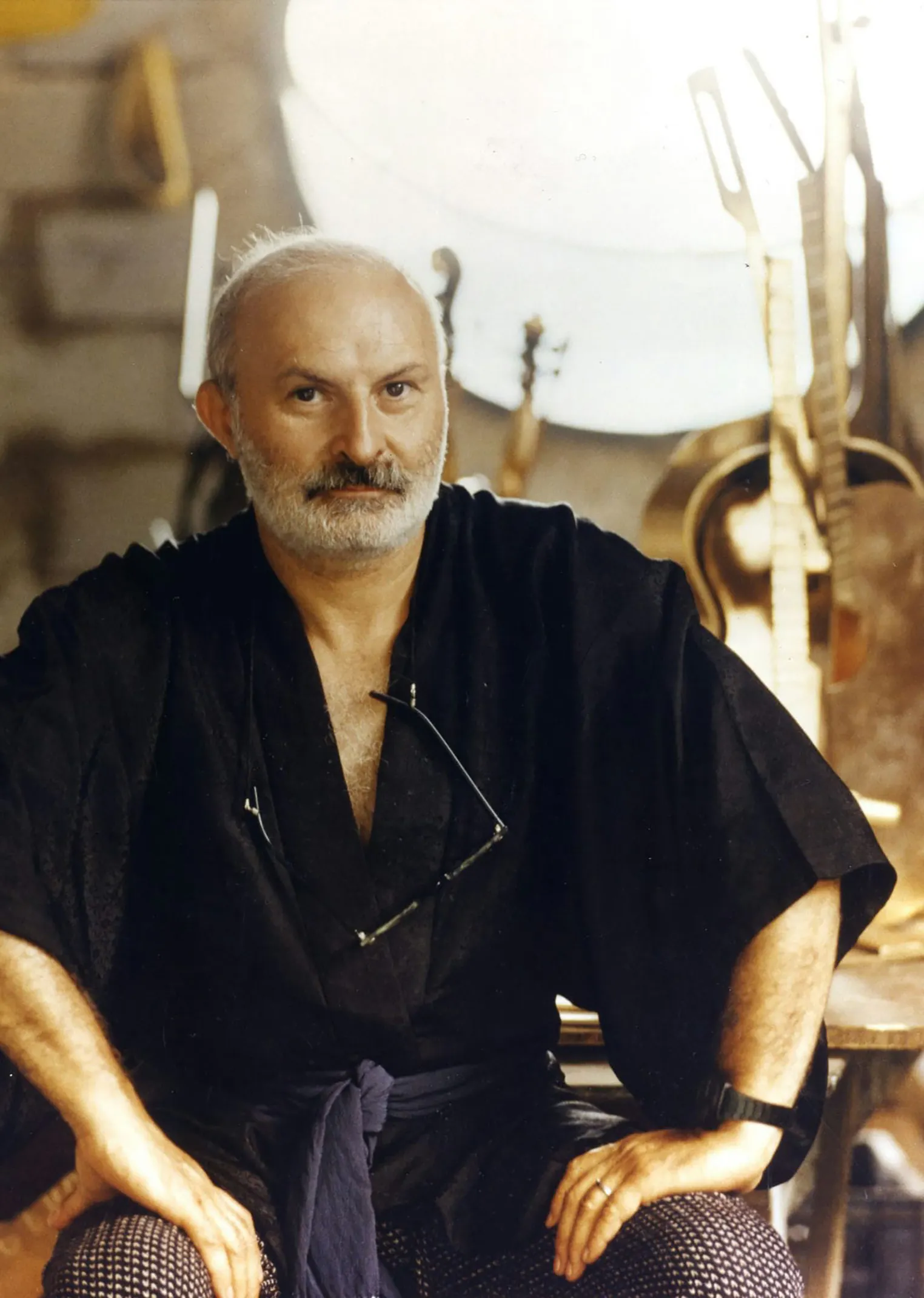
Arman,
Armand Pierre Fernandez was born in Nice on 17 November 1928. His father ran an antiques shop, painted and played the cello. He introduced his son to oil painting and fostered his interest in objects and music. Both would find their way into Arman’s work, from accumulations of everyday objects to those made from musical instruments. After studying at the École des arts décoratifs in Nice, he moved to Paris to study archaeology and Oriental art at the École du Louvre.
In 1957, a printer left the final d off his first name on an exhibition invitation; the following year, Arman adopted the spelling as his signature. In 1960, alongside Klein, Jean Tinguely, Daniel Spoerri, Raymond Hains, Jacques Villeglé and other artists, he signed the founding manifesto of Nouveau Réalisme, led by the critic Pierre Restany. Everyday objects became the very material of his work: his Accumulations assembled objects in series, while his Poubelles enclosed refuse in glass cases.
Arman settled in New York in 1963 and became an American citizen in the early 1970s. As his work entered public spaces, he explored sculpture on a monumental scale.
From 1985 onwards, the Statue of Liberty became one of his recurring motifs. In the Slices of Liberty series, Arman cut apart and reassembled this familiar figure in bronze, in the lead-up to the centenary of its inauguration. Around the same time, a conversation with Chrystiane Charles gave rise to the idea for the Liberté lamp. Arman designed it for her, as an expression of their friendship. Two silhouettes of the statue stand side by side; their bronze forms are divided into vertical strips, alternating green patina and gilding. Only one carries the torch, its flame rendered in frosted glass. The lamp brings into the world of lighting the process of cutting and recomposition that Arman was then exploring in his work on Liberty.
Arman died in New York in 2005, having held some five hundred solo exhibitions. His work is represented in the collections of MoMA, the Centre Pompidou, Tate and the Metropolitan Museum of Art.
