Paco Rabanne,
Francisco Rabaneda Cuervo was born on 18 February 1934 in Pasaia, in Spain’s Basque Country. His father, a colonel in the Republican army, was executed in 1937. His mother, head seamstress at Balenciaga, left Spain with her children in 1939. The family found refuge in France, and Paco Rabanne grew up in Brittany.
In 1951, he began studying architecture at the École des Beaux-Arts in Paris, where he remained for around ten years. He was particularly interested in reinforced concrete. To fund his studies, he designed accessories for couture houses. Balenciaga, Givenchy, Cardin and Courrèges commissioned him to create jewellery, buttons and decorative pieces. He entered fashion through accessories, at the meeting point of object and body.
On 1 February 1966, at the Hôtel George V, he presented his first collection: Twelve Unwearable Dresses in Contemporary Materials. The models walked barefoot to a composition by Pierre Boulez. Rhodoïd, plastic discs and metal rings formed garments without fabric, assembled like chain mail. His approach was already clear: to build a garment from modules, allowing the material and the act of assembly to determine its form.
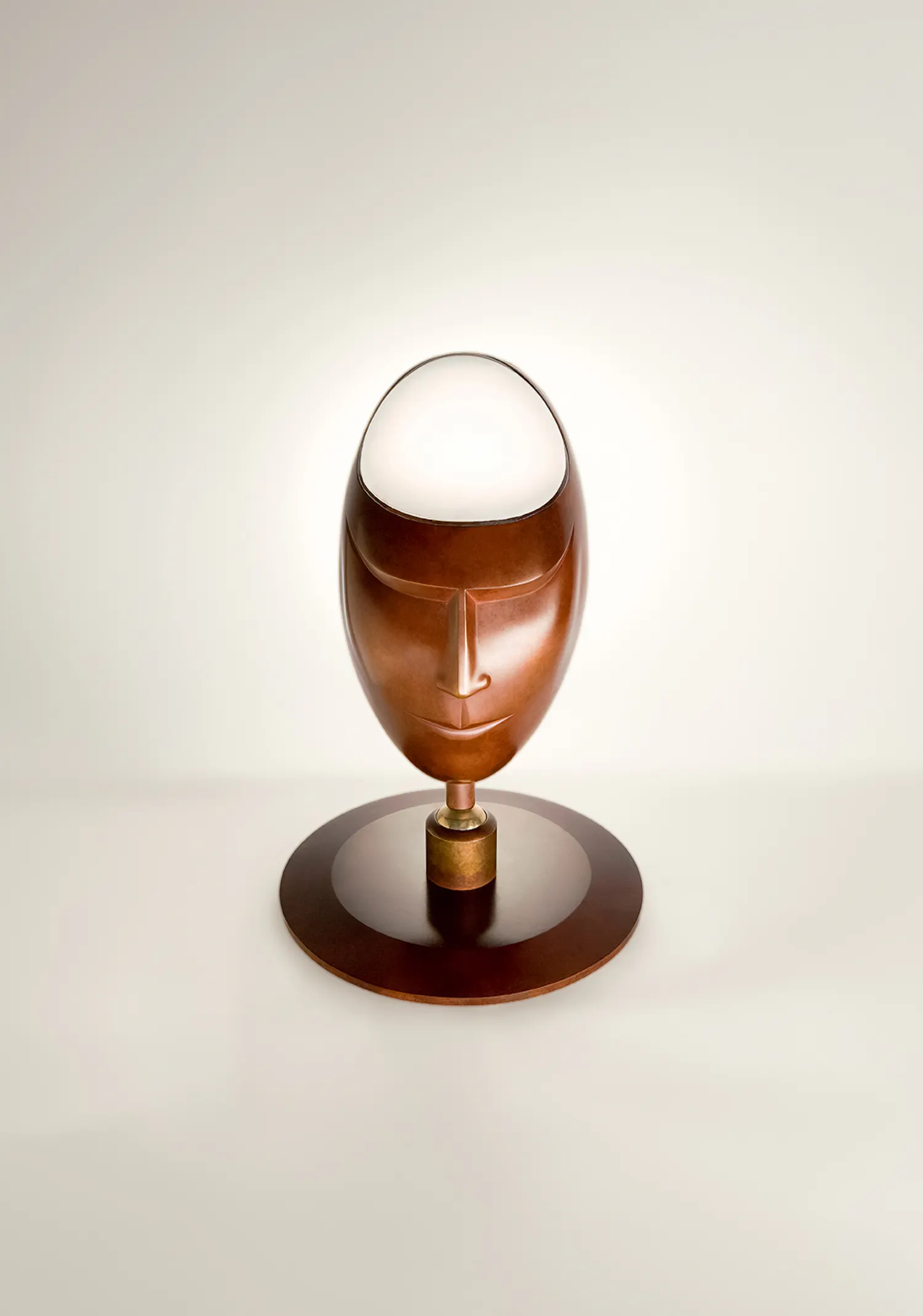
In the late 2000s, the maison Charles commissioned him under the artistic direction of Philippe Parent. He designed Atlante, produced in an edition of eight: an oval face in gilt bronze supports a deep blue glass dome, set on a broad polished disc. In architecture, an atlante is a male figure that supports a building in place of a column. Here, it supports the light.
After retiring from couture in 1999, Paco Rabanne was made an Officer of the French Legion of Honour in 2010. He died on 3 February 2023 in Portsall, Finistère, where he had lived for several years.